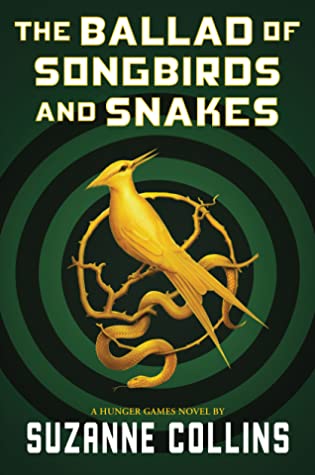
Review: The Ballad of Songbirds and Snakes by Suzanne Collins

Review: The Ballad of Songbirds and Snakes by Suzanne Collins

©Scholastic Press

The genre: Dystopian, YA

The gist: Prequel to the Hunger Games series focusing on President Snow’s formative years and the nascent days of the Hunger Games competition.

The background: The Hunger Games trilogy are some of my favorite books to read again and again—I love Suzanne Collins’s writing, worldbuilding, and characters. So I don’t know why I let this prequel sit on my shelf for months before finally diving in. I think it had to do with the mixed reviews I’d heard, and I was postponing being disappointed. I shouldn’t have been worried; reviews are nothing compared to your actual reading experience, and this was a great one.

The tea: I’m just going to come out and say I loved this book.

As a big Hunger Games fan, I thought this was a satisfying tale that did three things very well: It expanded on the history of Panem and the Games, it gave background and nuance to the eventually villainous Coriolanus Snow, and it made thought-provoking connections to the original trilogy.

The only complaint I could have about this book is the lack of action until about halfway through, and maybe some uneven pacing, but I don’t really care that it’s not action-packed.

It reads as more of a character study on Snow, and Collins spends a lot of time showing how he thinks, how he calibrates and adapts, how he works to keep up appearances, how he meticulously measures the consequences of his words and actions, the risk and the reward. We get to see that he’s naturally calculating and ambitious, but he was raised in the Capitol among the calculating, ambitious, and even ruthless. So, was he always destined to become an evil tyrant, or did the Capitol create a monster? It’s a classic nature versus nurture question, and it’s kind of fun to think about.

Beyond painting a clear picture of a young Snow, the book gives more info on the war that started the Hunger Games tradition and hints at how the Games grew from a bleak event that nobody even in the Capitol wanted to watch (the novel is set during the 10th Annual Hunger Games) to the sparkly, reality show phenomenon it became by Katniss’s time. Plus, it elaborates on a few other things from the trilogy that I won’t spoil here.

While I would read anything Collins wrote set in the HG world, she couldn’t have picked a better character to explore. It’s a twist on the typical villain origin story, giving the bad guy a dose of humanity, but ultimately showing that some villains might be just that.

The wrap-up: I’d suggest those who haven’t read The Hunger Games start with the trilogy first, but The Ballad of Songbirds and Snakes is a must-read for HG fans. I know some have been disappointed, but I think if you go into it ready to soak up knowledge of the dystopian world rather than be hit with a cliffhanger every other page, you’ll have a good time reading.

In any case, it got me excited enough to read through the trilogy yet again, this time with a new lens—and a prequel that enriches its source material is a success in my book.

The rating: ⭐⭐⭐⭐/5

“People aren’t so bad, really,” she said. “It’s what the world does to them.”

—Suzanne Collins, The Ballad of Songbirds and Snakes
Video

The evolution of YA: Invented by librarians

Learn how the Young Adult genre came to be in another of my favorite installments from PBS’s “It’s Lit!” series.

While we see the YA label everywhere now, it wasn’t put into use until the mid-twentieth century, partially because it wasn’t until around World War II that teenagers were even considered their own marketing demographic; before that, everything had been divided into two categories, Child or Adult.

“Books for Young Adults” was a term coined by librarians in 1944 as they gathered and made lists of books from both the Child and Adult categories that would appeal to adolescents—and “Young Adult” has stuck as a genre ever since.

TL;DW: “It’s a bit reductive to be dismissive of Young Adult [fiction]. First of all, it’s not just a niche genre. YA is remarkable for its wide appeal: 55% of YA books purchased in 2012 were bought by adults between 18 and 44 years old... Not only does YA shape younger audiences as readers, it is a genre that helps give its audience a lexicon for understanding that there is a complex world between childhood and adulthood.”

Quote

A Coney Island of the Mind, 13

by Lawrence Ferlinghetti

Not like Dante
discovering a commedia
upon the slopes of heaven
I would paint a different kind
of Paradiso
in which the people would be naked
as they always are
in scenes like that
because it is supposed to be
a painting of their souls
but there would be no anxious angels telling them
how heaven is
the perfect picture of
a monarchy
and there would be no fires burning
in the hellish holes below
in which I might have stepped
nor any altars in the sky except
fountains of imagination

2021 reading goals

2021 reading goals

Hope you all had a lovely and safe New Year!

Now that the Year-That-Shall-Not-Be-Named is over, I’m looking forward to making 2021 better—it shouldn’t be too hard. And part of that is more books.

While I’m not big on the pressure of New Year’s resolutions, joining the Goodreads Reading Challenge has been the one goal I like set for myself at the start of each year (or, at least since 2016 when I joined the site). It’s a great way to not only track what you’re reading but keep an archive of what you’ve read over time. It also helps you to push yourself to read a little more than you might do normally. Highly recommend joining!

My 2021 reading goals:

  • Read 60 books. In 2016, I set a goal of 20 books. Since then, the most I read in a year was 70. Last year I read 50. I’m disappointed I didn’t get to read more in lockdown; part of that was due to a demanding writing job that left me drained at the end of the day, to the point where I didn’t want more words in my face. So now I’m trying to get back to where I was. It’s surprising how easily you can get competitive with yourself every time you meet a reading goal. Even if you don’t use Goodreads, I recommend making a goal for yourself! No matter the number.
  • Finish A Dance with Dragons by George R. R. Martin!!! I’ve been reading this off and on since 2019, and it’s past time I finish it. I don’t know why it’s taking me so long when I actually like it more than the previous book in the Song of Ice and Fire series (A Feast for Crows) that took me less time. It’s all the extra details, they’re a bit much. I just want to see what happens but instead I get descriptions of food and ships and food again. I’m kind of just in it for Dany and Tyrion at this point, but I like them enough to push through. And I’m still hoping for a new book from Martin, sometime.
  • Read more Flannery O’Connor. Besides a few of her short stories in college, I haven’t read much of O’Connor. A friend and mentor of mine says O’Connor is her favorite author, and since I super-trust her taste I’ve been meaning to give this classic American writer more attention.
  • Read more Stephen King. As big a King fan as I am, there is still SO. MUCH. of his work I haven’t read. Mainly, because he has SO. MUCH. work. If ten of the books I read this year are King’s, I’d be happy with that.
  • Start reading War and Peace. I say start on the chance I run into a Dance with Dragons situation with this brick of a book, but I’m going to try to stay on track and read a little every day. I mostly want to read it because the musical based on it piqued my interest. I’ve always been intimidated by Russian literature, but I think I’m underestimating myself. Here goes nothing.

The first new book I’ve started this year is The Ballad of Songbirds and Snakes by Suzanne Collins, her 2020 prequel to The Hunger Games trilogy that I bought immediately and then let sit on my shelf for six months. Looking forward to revisiting Panem!
Here’s to books and better days! Thanks for reading.